Business Analysts
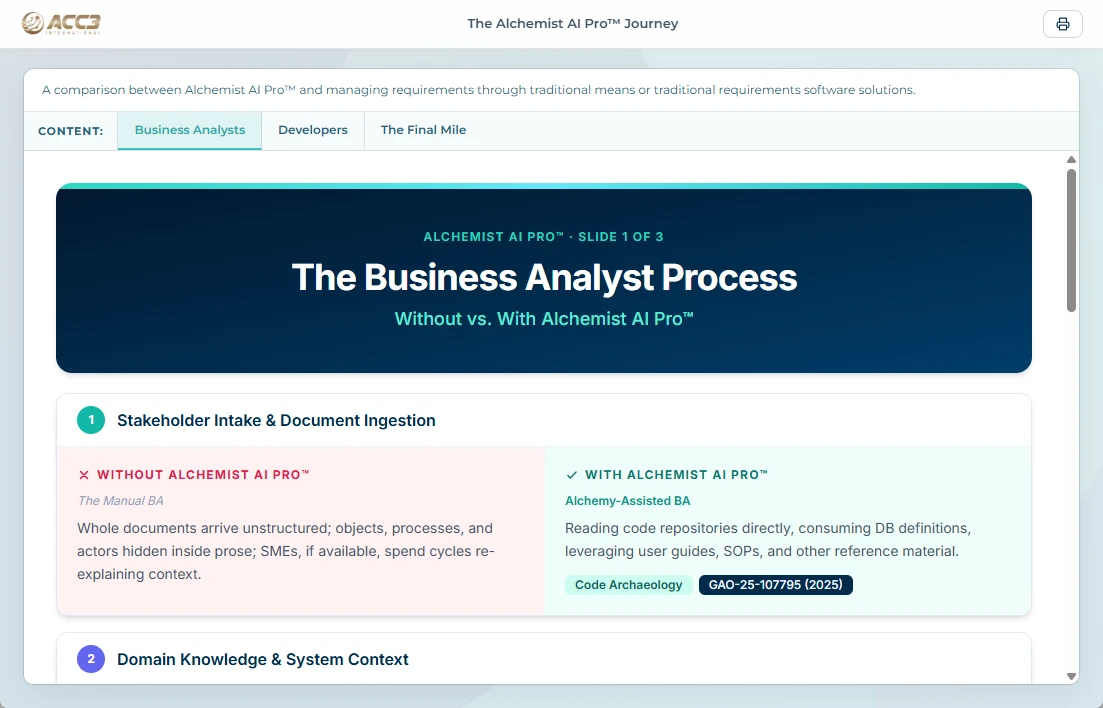
Alchemist AI Pro™ · Slide 1 of 3
The Business Analyst Process
Without vs. With Alchemist AI Pro™
Stakeholder Intake & Document Ingestion
Without Alchemist AI Pro™
The Manual BA
Whole documents arrive unstructured; objects, processes, and actors hidden inside prose; SMEs, if available, spend cycles re-explaining context.
With Alchemist AI Pro™
Alchemy-Assisted BA
Reading code repositories directly, consuming DB definitions, leveraging user guides, SOPs, and other reference material.
Domain Knowledge & System Context
Without Alchemist AI Pro™
Existing-system contracts, interface response times, and upstream/downstream context are captured ad hoc — if at all.
With Alchemist AI Pro™
Domain knowledge injected via proprietary ontology; existing systems tagged as system contracts with measurable interface SLAs.
Initial Feature Set — User-First
Without Alchemist AI Pro™
Analysts jump from the ask straight to epics and stories — the 'how' contaminates the 'what,' and user value is diluted.
With Alchemist AI Pro™
Conversation locked to high-level features only — the user's WHAT before any HOW (Working Backwards / PR-FAQ discipline).
Elaboration — Removing Ambiguity
Without Alchemist AI Pro™
Unstructured interviews; tacit assumptions slip through; ambiguity is discovered late — typically by developers, mid-sprint.
With Alchemist AI Pro™
Socratic dialogue drives use cases out of features; ambiguity, vagueness, and tacit assumptions surfaced before dev hand-off.
Actors / Objects / Processes / Business Rules
Without Alchemist AI Pro™
Whiteboards photographed and lost; word meanings commingle; capabilities and processes are conflated in the model.
With Alchemist AI Pro™
Capability ontology explicitly separated; new actor / object / process declared on demand and tagged in the model.
Epics / Stories / Acceptance Criteria
Without Alchemist AI Pro™
Free-form acceptance criteria; the eight named requirements defects (ambiguity, vagueness, complexity, etc.) persist into dev.
With Alchemist AI Pro™
EARS-formatted requirements eliminate the eight named defects; backlog priority captured at SME signoff for dev-ready turnover.
Developers
Alchemist AI Pro™ · Slide 2 of 3
The Developer Process
Without vs. With Alchemy Crew
Estimate and Project Planning
Without Alchemy Crew
Vibe Coding
Prompts to Claude Code, Kiro, and Codex produce plausible-looking code with no scope baseline; estimates are gut-feel; "done" is undefined. Scope creep is invisible until it ships broken.
With Alchemy Crew
Alchemy-Assisted Dev
EARS-validated stories drive sizing; cross-feature dependencies traced before sprint start; every estimate is backed by structured acceptance criteria, not a prompt guess.
Specs Across the Application
Without Alchemy Crew
Each Claude Code / Kiro / Codex session is siloed - no shared data model, no API contracts, no cross-feature vocabulary. Schemas generated today contradict what was scaffolded last sprint.
With Alchemy Crew
Live ontology - actors, objects, processes, rules - declared once and referenced everywhere; cross-feature consistency enforced by Alchemy Crew before code is written.
MVP for User Experience
Without Alchemy Crew
UI direction is "make it look like X" - no persona grounding, no test-case derivation, no acceptance baseline. MVPs ship passing vibes, not validated user journeys.
With Alchemy Crew
Working Backwards locks the WHAT before any HOW; test cases derived from use cases, not invented post-hoc; acceptance criteria precede the first prompt to the AI tool.
Back-End and Database
Without Alchemy Crew
Codex / Claude Code scaffold whatever schema the next prompt implies; routes accumulate without data contracts; migrations pile up as the model evolves via more vibe sessions.
With Alchemy Crew
Routes and schema derived from validated system contracts with measurable interface SLAs; every table and endpoint traces back to the requirement that demanded it.
Actors / Objects / Processes / Rules
Without Alchemy Crew
Vibe coding collapses domain vocabulary - "user," "customer," "profile" used interchangeably across AI sessions; business rules are buried in generated code, invisible and untestable.
With Alchemy Crew
Canonical capability ontology enforces naming discipline; business rules are declared as first-class artifacts before code generation, not reverse-engineered from AI output after the fact.
Epics / Stories / Acceptance Criteria
Without Alchemy Crew
Stories are ad hoc prompts - "build a login flow" - with no acceptance criteria; Claude Code / Kiro / Codex ship passing tests against undefined expectations; "done" means it compiled once.
With Alchemy Crew
EARS-formatted AC generated from Alchemy Crew's spec pipeline; every commit tagged to its spec, test case, and use case - full traceability from requirement to merge.
The Final Mile
Alchemist AI Pro™ · Slide 3 of 3
The Final Mile
Without vs. With Alchemy Away Team
Fix Triage and Root-Cause Analysis
Without Alchemy Away Team
Ad Hoc Patching
Fixes target the first error in the log; AI tools patch the visible symptom without anomaly classification; regressions compound because origin and impact are never separated.
With Alchemy Away Team
Guardrail-Driven Repair
The Away Team classifies each anomaly by origin and impact before writing a single line; diagnostics, UX empathy, and architecture are all examined - fixes trace back to the spec that defined correct behavior.
Repair Intent and Application Context
Without Alchemy Away Team
AI debug sessions start cold with no memory of architectural intent; the LLM reasons backward from current behavior - complexity accumulates with every patch, exactly as Lehman's Law predicts.
With Alchemy Away Team
The Away Team reads Tasks, Specs, and Tests before reading code; full cross-feature context is held; complexity is actively measured and managed - fixes are driven by original intent, not current behavior.
Full User Experience Validation
Without Alchemy Away Team
UX is limited to the happy path; HTTP 200 = done; error states, empty states, RBAC boundaries, and exception flows are discovered by users in production, not by the team before deploy.
With Alchemy Away Team
The Away Team maps effectiveness, efficiency, and satisfaction across the entire journey - sidetracks, edge cases, and exception paths included; ISO 9241-11 usability criteria are exercised, not assumed.
Back-End and Deployment Validation
Without Alchemy Away Team
Route and DB fixes are applied in isolation; no signal on downstream impact; latency spikes and error-rate regressions surface in production because no cross-layer signal was monitored before deploy.
With Alchemy Away Team
The Away Team monitors the four golden signals - latency, traffic, errors, saturation - across all service layers; root cause identified before the patch is written; all contracts validated before merge.
RBAC, Patterns, and Route Comprehension
Without Alchemy Away Team
RBAC is patched as if-else blocks; role boundaries are implicit and untested; a single vibe prompt can silently break access for an entire user class with no guardrail to catch it.
With Alchemy Away Team
The Away Team treats roles as declared first-class actors; every route is mapped to its authorized role set per the Ferraiolo-Kuhn RBAC model; reuse and exception patterns are explicit, tested, and documented before merge.
Spec-First Repair and Verification
Without Alchemy Away Team
Developers read the code to understand the bug; the fix is whatever makes the failing test green - no reference to original specification; every patch adds silent undocumented assumptions to the system.
With Alchemy Away Team
Cleanroom discipline: the Away Team reads the spec before the code; correctness is verified against original intent; a repair that deviates from spec triggers a spec update first, not a code update.